
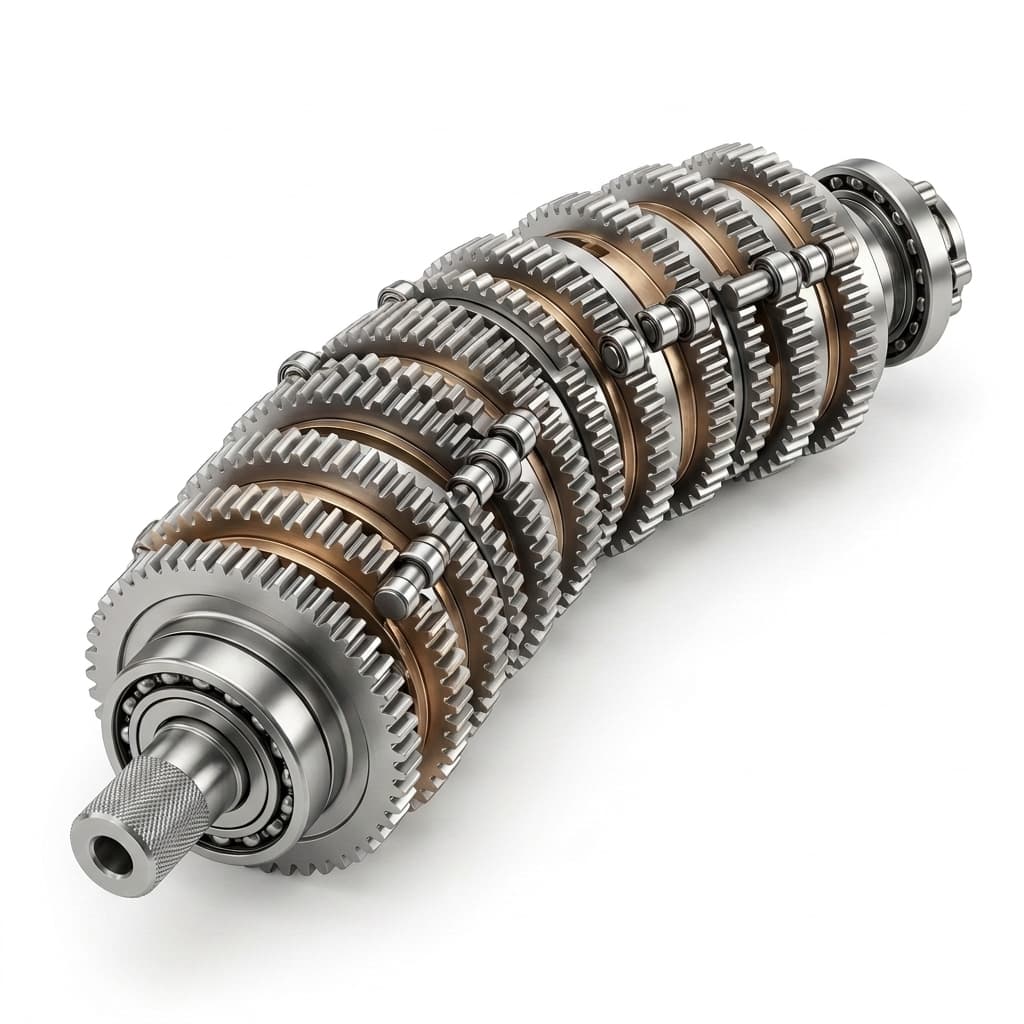
Understanding Low Backlash in Precision Gearboxes: Where Cycloidal Drives Fit
A technical exploration of how low backlash is specified and verified, comparing cycloidal preload with harmonic and planetary gearbox tradeoffs.
Key Takeaways for Sourcing Engineers:
- What is a Low-Backlash Target? A specified lost-motion limit tied to model, preload, torque level, and measurement method.
- The Mechanism: Cycloidal drives can use precise interference fits (preload) and simultaneous multi-pin engagement to reduce lost motion.
- Hysteresis Curve: Precision should be reviewed with torsional rigidity and hysteresis behavior, not just a hand-feel free-play check.
- Metrology Standard: Field validation often needs mechanical leverage and a documented test method, because manual twisting cannot overcome factory preload static friction.
Whether you are building a compact robot joint, CNC rotary table, or wafer-handling axis, backlash can directly affect tool-tip accuracy.
Backlash (also referred to as lost motion) is the mechanical clearance or "play" between mating components. In a gearbox, it is the angular distance the output shaft can rotate without the input shaft moving. At the end of a 2-meter robotic arm, a mere 3 arc-minutes of gearbox backlash translates to nearly 2 millimeters of positioning error at the tool tip.
When B2B engineers require a low-backlash motion package, they generally evaluate three technologies: precision planetary gears, harmonic drives (strain wave gears), and cycloidal reducers. Here is an engineering breakdown of where cycloidal drives can fit high-durability precision applications.
1. The Tradeoff in "Precision" Planetary Gears: Wear and Shear
Standard planetary gearboxes rely on the involute meshing of gear teeth. To prevent the teeth from binding, grinding, and generating extreme heat, a microscopic gap (backlash) is mathematically required.
Manufacturers create "precision" planetary gearboxes by machining the teeth to tight tolerances to minimize this gap. However, torque is transmitted through tooth contact, so backlash growth should be reviewed against load, lubrication, life target, and inspection interval.
The result: A precision planetary gearbox can be the right choice for many smooth, high-efficiency axes, but its backlash target should be checked over the expected service life rather than judged only from the day-one catalog value.
2. The Tradeoff in Harmonic Drives (Strain Wave Gearing): Fatigue
Harmonic drives are known for very low backlash and are heavily used in lightweight cobots. They achieve this using a different concept: an elliptical wave generator deforms a thin, flexible metal cup (the flexspline) into a circular outer spline.
Because the teeth of the flexspline are forced outward into the rigid spline with controlled engagement, backlash can be very low. However, this design introduces tradeoffs:
- Metal Fatigue: The flexspline repeatedly deforms, so life should be checked against duty cycle, speed, and torque.
- Shock Loads: Sudden impact, emergency stop, or accidental collision can require additional safety factor and validation.
- Torsional Stiffness: The flexible cup can introduce wind-up under load, so stiffness should be compared against the positioning and machining requirements.
3. The Cycloidal Option: Epitrochoidal Rolling Preload
Cycloidal reducers can reduce backlash through rolling preload and load sharing, while avoiding some of the tradeoffs found in tooth-mesh or flexspline transmissions.
Instead of meshing gear teeth or deforming metal cups, cycloidal drives use an eccentric shaft to drive a solid steel cycloidal disc (machined with epitrochoidal curves) against an outer ring of stationary cylindrical pins.
The Mechanics of Low Backlash
To reduce lost motion, cycloidal manufacturers can design the cycloidal disc profile and the pins with a slight interference fit (preload). Because the transmission relies on rolling elements, the preload target must be balanced against efficiency, heat, lubrication, and wear requirements.
At any given moment, multiple lobes on the cycloidal disc share load against the pins, which helps distribute torque across the mechanism.
Why Preload and Load Sharing Matter
- Sustained Precision Over the L10 Life: Because torque is distributed across multiple rolling contacts rather than concentrated on a single gear tooth, a properly sized cycloidal reducer can hold a low-backlash target through a longer duty profile. The accepted backlash limit should still be defined by model, preload, duty cycle, and inspection method.
- Torsional Rigidity: Compared with flexible transmission elements, hardened cycloidal components can support high torsional stiffness when the reducer is correctly sized for the load case.
- Shock Load Review: Load sharing can improve shock-load tolerance versus tooth-mesh gearboxes, but permissible peak torque, impact duration, and safety factor should be confirmed from the selected reducer's data sheet or validation test.
4. Understanding the Hysteresis Curve
When evaluating a low-backlash reducer, engineers should examine the Hysteresis Loss Curve provided by the manufacturer. Backlash is just one point on this curve.
A hysteresis curve plots the angular deflection (arc-minutes) against the applied torque (Nm) as torque is applied in the positive direction, then reversed to the negative direction, and brought back to zero.
- Lost Motion: The actual mechanical clearance measured at plus/minus 3% of rated torque.
- Hysteresis Loss: The width of the hysteresis loop when torque returns to zero. This represents the energy absorbed by internal friction and elastic deformation.
In a well-sized cycloidal drive, the hysteresis loop should be narrow enough for the application's positioning target. The slope indicates Torsional Stiffness, meaning how much the output flange deflects under applied torque. Harmonic drives may show more elastic wind-up in some load ranges, so the comparison should be made against the same torque and test method.
Hysteresis Curve: Cycloidal vs Harmonic Drive
- Low-torque response
- Shallower slope before full stiffness is reached.
- Hysteresis width
- Wider loop from elastic cup deformation.
- Low-torque response
- Measured resistance around the low-backlash target.
- Hysteresis width
- Loop width depends on preload, model size, and torque level.
Backlash is only one point on the curve; the slope around that point shows how much torque the reducer can resist before measurable angular deflection appears.
5. How to Measure Backlash in the Field
If you are validating a prototype robotic joint, measuring low backlash requires a documented metrology setup. Some teams adapt principles from ISO 9283 (Manipulating industrial robots — Performance criteria and related test methods), but the reducer supplier and buyer should agree the exact acceptance method.
Warning: Do not judge low backlash by twisting the output shaft by hand. Internal preload can require mechanical leverage to overcome static friction and register lost motion.
- Lock the Input Shaft: The servo motor or input shaft must be rigidly locked (e.g., using the servo brake or a mechanical locking collar).
- Attach a Lever Arm: Mount a rigid lever arm (e.g., 500mm long) to the output flange.
- Place a Dial Indicator: Position a highly sensitive micron dial indicator at a known radius (e.g.,
R = 200 mm) on the lever arm. - Apply Torque: Apply plus/minus 3% of the rated torque to the lever arm using a digital torque wrench.
- Calculate: Measure the total displacement
Don the dial indicator. Backlash (in arc-minutes) is calculated as:Backlash = (D / R) x ((180 x 60) / pi)
Conclusion for OEM Buyers
If you are building a lightweight desktop robot where mass and package size dominate the design, a harmonic drive can remain a valid choice.
When your OEM project needs low backlash, high stiffness, and documented shock-load review in a compact reducer package, a micro cycloidal reducer is worth evaluating alongside harmonic and planetary options.
To evaluate a low-backlash cycloidal reducer for your next project, contact our engineering team with your torque, ratio, interface, duty cycle, and acceptance method.
Author

Categories
More Posts
Cycloidal vs Planetary Gearboxes: Tradeoffs for Compact Robotics
An engineering comparison between cycloidal reducers and planetary gearboxes, covering backlash, torsional stiffness, load path, package size, and shock-load review.
How to Select the Right Cycloidal Reducer for AGV and AMR Drive Wheels
A highly technical sizing guide for OEM engineers selecting cycloidal reducers for Automated Guided Vehicles (AGVs). Includes torque formulas, radial load calculations, and duty cycle analysis.