
Cycloidal vs Planetary Gearboxes: Tradeoffs for Compact Robotics
An engineering comparison between cycloidal reducers and planetary gearboxes, covering backlash, torsional stiffness, load path, package size, and shock-load review.
Key Takeaways for Sourcing Engineers:
- Load Path: Planetary gearboxes transmit torque through meshing gear teeth; cycloidal reducers distribute load through rolling pins and cycloidal discs.
- Wear Profile: Backlash growth should be compared against duty cycle, lubrication, preload, and the selected model's inspection method.
- Shock Resistance: Emergency-stop torque needs a checked peak-torque rating and safety factor, regardless of reducer type.
- TCO: Total cost depends on purchase price, replacement interval, downtime risk, validation cost, and maintenance access.
Specifying the main joint transmission for compact robotics, EOAT, or AGVs usually comes down to two options: a cycloidal reducer or a precision planetary gearbox.
Both share a coaxial format, but their internal load paths are different. Getting this wrong at the design stage can result in early field failures, positioning drift, or an over-specced BOM.
Here is a breakdown of structural differences, common failure modes, and RFQ checks to help you narrow the right transmission for your next project.
1. The Core Mechanical Difference: Shear vs. Compression
Planetary Gearboxes: Tooth Contact and Shock Load
Planetary gearboxes distribute the load across multiple "planet" gears revolving around a central "sun" gear, all contained within an outer ring gear. Torque is transmitted through the gear teeth contact points. From an engineering perspective, this means tooth contact stress, lubrication, gear geometry, and the number of engaged teeth become critical when sizing for shock loads.
Cycloidal Reducers: Rolling Compression
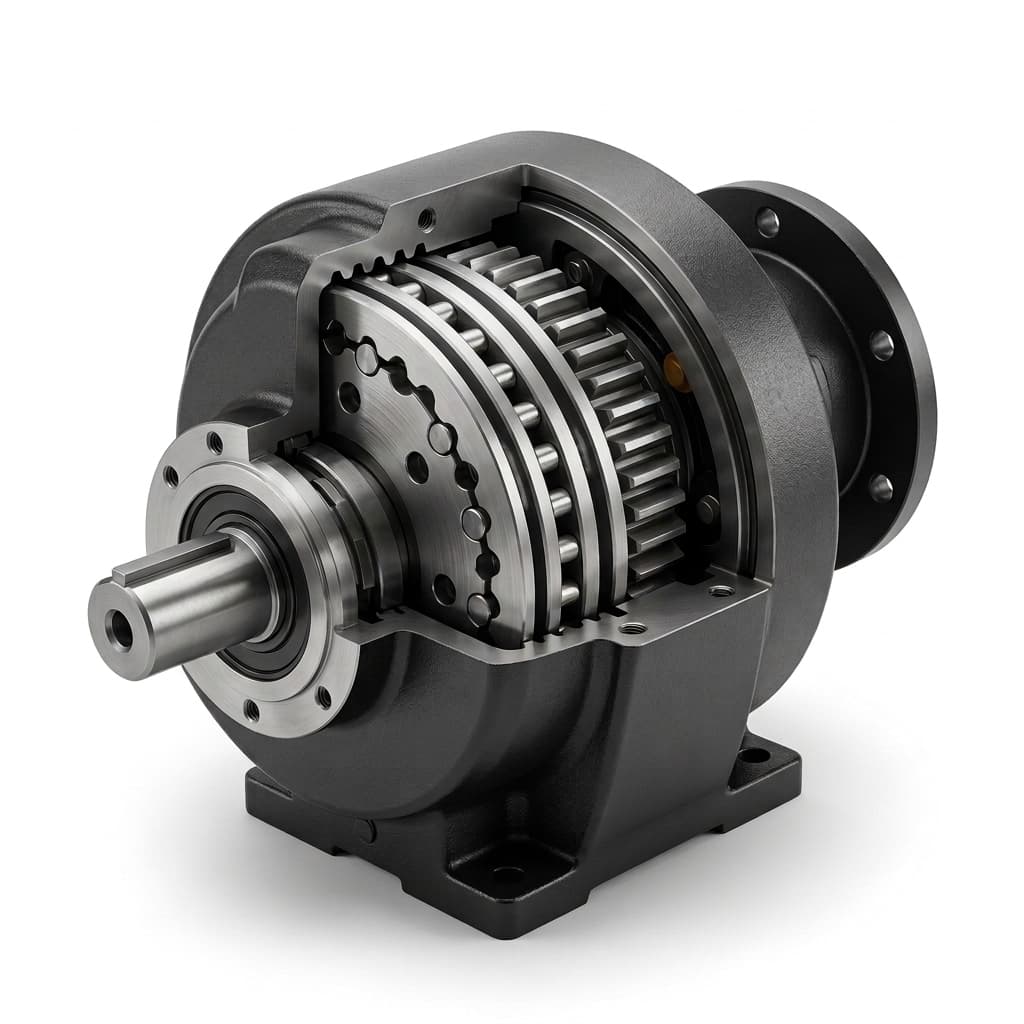
Cycloidal reducers utilize an eccentric shaft to drive a cycloidal disc (featuring an epitrochoidal profile) which rolls inside a stationary ring gear lined with cylindrical pins. Torque is transmitted via rolling compression (Hertzian contact stress) rather than a conventional gear mesh. Depending on the design, multiple pins and lobes can share load at the same time.
Force Distribution Comparison
Shear stress is concentrated on a limited number of gear teeth.
load-path comparison
Rolling compression spreads shock load across many pins at once.
Engineering Tip: Emergency-stop torque can exceed the allowable load on undersized planetary gear teeth. Cycloidal drives spread load across multiple pins and rollers, but the selected model still needs a checked peak-torque rating and safety factor.
2. Technical Comparison Matrix
| Specification | Precision Planetary Gearbox | Micro Cycloidal Reducer |
|---|---|---|
| Typical Backlash | often 3 to 10 arc-minutes | low-backlash designs available; target must be specified |
| Single-Stage Ratio | 3:1 to 10:1 | 11:1 to 119:1 |
| Shock Load Capacity | often 150% to 200% of nominal | model-dependent peak-torque rating |
| Torsional Stiffness | Moderate | High, model-dependent |
| Efficiency | 90% - 97% | 85% - 92% |
| Axial Length | longer when stages are stacked | can be short in flat designs |
3. Shock Load and Emergency Stop Review
In industrial robotics, emergency stops (E-stops) and accidental collisions are real design cases.
When a robotic arm carrying a heavy payload hits a barrier, kinetic energy transfers back through the joints into the gearbox. In an undersized planetary gearbox, this torque spike can exceed the allowable tooth load and cause gear damage.
Because a cycloidal drive distributes impact across multiple pins and rollers, it can be a good candidate for cobots, AGVs, and other applications with emergency-stop or collision load cases. Confirm the selected reducer's peak-torque rating, impact duration, and validation method before treating shock tolerance as a design margin.
4. Backlash Review over Service Life
Both technologies can be manufactured to high precision out of the box, but buyers should ask how the backlash target is maintained over the intended service life.
- Planetary Degradation: To prevent binding and thermal expansion lockup, planetary gears need controlled clearance. Backlash growth depends on load, lubrication, duty cycle, and gear quality, so acceptance should include a service-life assumption.
- Cycloidal Sustained Precision: Cycloidal drives can use a slight interference fit (preload). Because the internal action is rolling rather than sliding, a properly sized design can hold a low-backlash target through demanding duty cycles, but the target should still be tied to model size and inspection method.
Total Cost of Ownership (TCO) Considerations
While a precision planetary gearbox may have a lower initial purchase price, the TCO comparison depends on downtime cost, replacement access, duty cycle, shock-load frequency, and validation requirements. For dynamic robotic axes, buyers should compare the total installed cost rather than purchase price alone.
5. Form Factor and High Reduction Ratios
Achieving high torque at low speeds requires high reduction ratios. To achieve a 100:1 ratio, a planetary gearbox requires combining two or three separate planetary stages sequentially. This stacking significantly increases the axial length of the gearbox, pushing the robotic joint wider and increasing the lever-arm effect on the chassis.
A cycloidal reducer can support high single-stage ratios in a compact axial package. In joint design for robots, exoskeleton drives, or indexing modules, even a small axial-width reduction can improve packaging and cable routing.
6. Kinematic Error (Transmission Error)
While backlash is the play when reversing direction, Kinematic Error (or Transmission Error) is the deviation between the theoretical output position and the actual output position during continuous rotation.
Even if a planetary gearbox has low backlash, microscopic inconsistencies in tooth cutting can create ripple in the velocity profile. Cycloidal drives, due to multi-lobe engagement, can help average out machining tolerances. This is useful for applications requiring smooth continuous path tracking, such as dispensing robots or welding arms, but the accepted kinematic error should be verified on the chosen reducer.
7. Material Science and Heat Treatment
The compression loads in a cycloidal drive make material selection and heat treatment important RFQ topics. Depending on the load class, suppliers may specify bearing steels such as GCr15 or AISI 52100, controlled quenching, and hardness targets such as HRC 58-62. Ask the supplier how cycloidal discs, pins, rollers, and bearings are inspected for hardness, surface finish, and fatigue assumptions before approving a repeat-order program.
Summary: When to Specify Which?
Specify a Planetary Gearbox when:
- You need continuous, high-speed rotation (e.g., spindle drives, conveyors).
- High efficiency and low heat generation are the primary priorities.
- The application operates with smooth, predictable loads and limited shock-load exposure.
Specify a Micro Cycloidal Reducer when:
- You are designing robotic joints, indexing tables, or AMR drive wheels.
- You require a defined low-backlash target for precision robotic positioning.
- The axial space is strictly constrained (requiring a flat profile).
- The system needs documented shock-load review for emergency stops.
Need an engineering review for your transmission design? Contact our technical sales team with your torque, speed, and spatial constraints for a customized cycloidal reducer sizing recommendation.
Author

Categories
More Posts
Understanding Low Backlash in Precision Gearboxes: Where Cycloidal Drives Fit
A technical exploration of how low backlash is specified and verified, comparing cycloidal preload with harmonic and planetary gearbox tradeoffs.
How to Select the Right Cycloidal Reducer for AGV and AMR Drive Wheels
A highly technical sizing guide for OEM engineers selecting cycloidal reducers for Automated Guided Vehicles (AGVs). Includes torque formulas, radial load calculations, and duty cycle analysis.