
Engineering guide
Brushless Motor Cycloidal Reducer Lubrication Guide
Use the reducer’s approved grease, fill and service interval. Check mounting, motor heat and duty together before release.
Published · Sources checked and content updated
Published by Micro Cycloidal. Public-source review and engineering synthesis; no independent hardware testing is claimed. Send a technical correction.
1. Four decisions before specifying grease
Start with the reducer specification
Brushless motor type alone does not select a grease. Obtain the approved product, quantity and mounting drawing for the exact reducer.
Use the assembly temperature limit
A lubricant test temperature is not permission to run the gearbox at that temperature. Measure the assembled motor and reducer under the intended duty.
Fill by the approved quantity
Factory fill, replenishment and overhaul quantities are different instructions. A generic cavity percentage cannot replace the assembly drawing.
Treat small travel as a separate case
RV-N guidance calls for consultation at output travel of 10° or less. Specify output travel and load history when requesting lubrication approval.
2. What the public evidence establishes
These are scoped manufacturer statements, followed by our interpretation. They are not interchangeable specifications for all cycloidal gearboxes.
| Finding | Evidence strength and locator | Decision boundary |
|---|---|---|
| Reducer surface ≤60°C; inspect lubricant earlier when surface is ≥40°C | Manufacturer catalog, printed p. 61 | Applies to the products covered by that catalog. A grease temperature rating does not override the assembly limit. |
| 20,000 h standard lubricant replacement reference | Manufacturer catalog, printed p. 61 | Conditional reference, not guaranteed life. Deterioration and contamination can require earlier replacement. |
| Output travel of 10° or less needs consultation | RV-N catalog, printed p. 22 | Supplier review is required; a universal automatic sweep is not established. |
| NLGI 2 is specified for some industrial cycloid sections | Cyclo 6000 manual, §8.4.2, Table 8-18 | Counterexample to “NLGI 00/0 is mandatory.” Not approval for a compact servo reducer. |
| Your fill mass, seal compound and service interval | Not established by the sources for an unspecified assembly | Obtain a current drawing and written lubricant approval from the reducer or actuator supplier. |
How to resolve conflicting advice: match the exact model, document revision, mounting and definition of temperature. Escalate conflicts to the OEM before service; do not average incompatible limits.
3. Compare lubricant properties without inferring approval
The following are representative laboratory values in Nabtesco’s May 2026 catalog, printed p. 56. They are not guaranteed field performance. All three listed greases use lithium soap with synthetic hydrocarbon and mineral base oils.
| Property / test | RVGREASE LB00 | VIGOGREASE RE0 | MOLYWHITE RE No.00 |
|---|---|---|---|
| Base oil viscosity at 40°C (mm²/s), ASTM D445 | 71.8 | 81.3 | 32.3 |
| Worked penetration, ASTM D217 (0.1 mm) | 410 | 398 | 415 |
| Dropping point, ASTM D566 (°C) | 188 | 190 | 193 |
| Starting torque at −30°C (mN·m), JIS K2220 §18 | 140 | 270 | 110 |
Interpretation: viscosity, penetration and cold starting torque describe different properties. These tests cannot rank complete assemblies or determine a field interval. A dropping point is not a continuous housing temperature rating.
| Route | Potential value | What still needs approval |
|---|---|---|
| Keep the documented factory fill | Preserves a known specification and service history | Exact lubricant identity, storage history and approved operating envelope |
| Change to another grease | May address a documented application limitation | Compatibility, changeover method, seals and qualification test; similarity alone is insufficient |
| Use an oil-lubricated configuration | Can support a different thermal and service design | Oil-specific housing, level, orientation, seals and service procedure |
Nabtesco’s lubricant range includes both grease and oil. Its specific Molywhite/Vigogrease mixing statement should be read with the catalog’s instruction to consult about mixing. Neither is a general approval for other lubricants or reducer brands.
4. Check motor and reducer heat as an assembly
Suggested engineering method: compare motor, flange, reducer housing and ambient readings at identified sensor positions. Do not substitute motor winding temperature for reducer surface temperature. The diagram identifies locations to investigate; it predicts no temperatures or heat-transfer percentages.
- Motor sensor location
- Mounting flange interface
- Reducer housing surface sensor
| Record | Keep constant for comparison | Acceptance basis |
|---|---|---|
| Reducer surface temperature | Sensor location, attachment and measurement method | Current reducer assembly limit, not the lubricant dropping point |
| Motor and flange temperature | Load, speed profile, cooling and ambient | Motor and actuator limits; assess coupling to the reducer |
| Input speed and current | Rated vs peak speed, acceleration and unloaded vs loaded test | Approved reducer input envelope and commissioned baseline |
| Output travel and dwell | Output angle, holding torque and reversal history | Review small travel separately; use supplier-approved motion only |
The RV-N catalog explains that load and duty may exceed its thermal limit even below an allowable speed. See printed pp. 22–23. For a new assembly, obtain acceptance criteria before testing and stop on a breached limit or abnormal behavior.
5. Fill quantity depends on mounting and assembly geometry
Use the supplier’s mass or volume, units and filling datum. A cavity percentage does not identify whether the volume includes a motor adapter, bearings or internal passages. The RV-N lubrication drawings illustrate why orientation and the mating components matter. See printed pp. 50–51.
| Assembly | Drawing or detail to submit | Release condition |
|---|---|---|
| Horizontal shaft | Final adapter geometry, ports and lubricant space | Approved fill quantity and filling procedure |
| Vertical motor-up | Section drawing and upper bearing lubricant path | Approved distribution and mounting-specific quantity |
| Vertical motor-down | Motor-side seal arrangement and any brake/encoder separation | Approved sealing and service instructions |
| Articulated or changing orientation | Full orientation range, dwell and output travel | Actuator supplier’s qualification for the complete motion envelope |
Avoid improvised changes
Do not add a permanent vent, increase fill by a fixed percentage, change seal compounds or add tracer dye without assembly approval. A replenishment discharge port serves a documented service procedure; it does not imply that every sealed robot joint needs an open vent.
6. Turn the manual into a service checklist
The sequence below is our preparation checklist, not an OEM filling or overhaul procedure. Cyclo 6000 §8.4 distinguishes serviceable units and warns that excess grease can cause agitation heat and motor-side leakage. Follow the exact unit’s instructions for ports, quantities and machine state.
1. Identify
Record reducer serial number, ratio, mounting, lubricant and manual revision. Determine whether the unit is sealed, replenishable or oil-lubricated.
2. Make the machine safe
Use the machine’s approved isolation and load-support procedure before inspection or opening. Any OEM-required powered service needs its own authorized guarded procedure.
3. Confirm the service instruction
Distinguish initial fill, top-up and overhaul quantities. Identify the prescribed fill and discharge ports and approved lubricant handling method.
4. Record and release
Record product and batch, quantity, observations and operating hours. Recommission under the approved procedure and compare with the baseline.
No universal solvent flush, warm-up duration, grease-gun pressure or speed sequence is established here. If the current lubricant is unknown, obtain a supplier-approved recovery procedure before adding material.
7. Separate lubricant life from maintenance scheduling
The Nabtesco replacement reference in the evidence register is conditional. Industrial replenishment and overhaul are also separate operations. Neither can be transferred to an unspecified brushless actuator simply because it uses cycloidal gearing.
Why a generic thermal life calculator is insufficient
SKF’s bearing research describes a 15°C life-halving rule of thumb within a safe grease temperature window and empirical bearing life models. That does not validate a 10°C rule based on gearbox housing temperature, nor arbitrary multipliers for motor RPM, duty or mounting. A complete reducer needs its own applicable evidence.
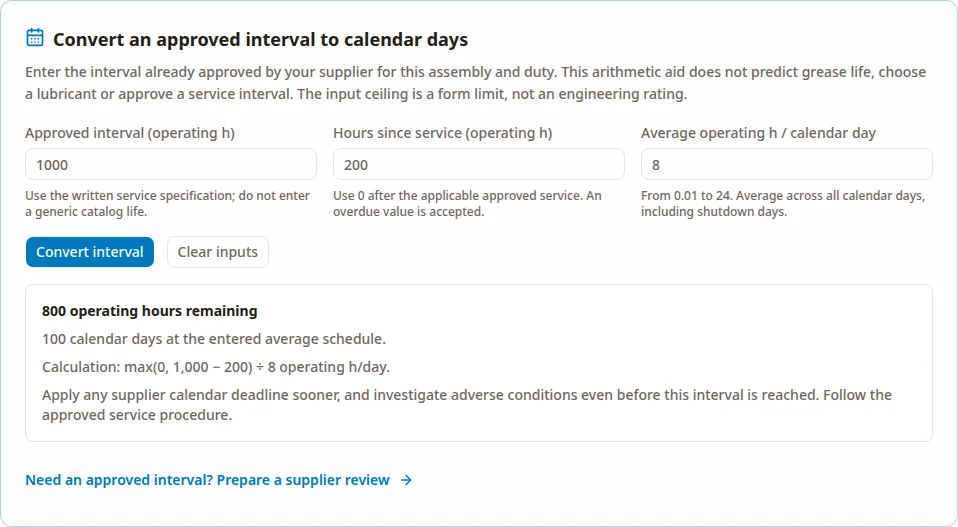
Convert an approved interval to calendar days
Enter the interval already approved by your supplier for this assembly and duty. This arithmetic aid does not predict grease life, choose a lubricant or approve a service interval. The input ceiling is a form limit, not an engineering rating.
No conversion yet. Complete the three fields using your approved service record.
8. Use symptoms to guide inspection, not diagnose by guesswork
This is a proposed triage record. Symptoms can have several causes; no public evidence reviewed here establishes one universal current, vibration or temperature-change alarm threshold for your actuator.
| Observation | What to compare | Next action |
|---|---|---|
| Rising housing temperature | Matched load, ambient, sensor location, cooling and recent service | Stop on the approved limit or abnormal trend; investigate before adding or removing grease |
| Lubricant at the motor interface | Seal condition and service history; brake or encoder compartment if applicable | Remove from service when motor-side contamination is suspected; obtain the prescribed inspection |
| New noise or current change | Mechanical load, alignment, controls and commissioned baseline | Investigate the assembly; do not attribute the symptom solely to lubricant |
| Small-angle positioning duty | Output travel, dwell and load concentration | Request motion-specific approval rather than program an unrestricted sweep |
| Unknown or changed lubricant | Service records, product identity and sample condition | Suspend substitution; ask for an approved identification/changeover route |
SKF describes churning, bleeding, starvation and ageing as distinct mechanisms. They explain why a symptom deserves investigation, not why a particular failure has been proved. Mechanism reference.
9. Three application review examples
Illustrative decision paths written for this guide; these are not measured customer cases or verified performance results.
Robot joint with short travel
- Premise
- A servo joint repeatedly positions through a small output angle.
- Review
- Submit travel, holding torque, orientation and cycle history. Ask whether the chosen reducer is qualified for that motion.
- Required outcome
- A documented motion envelope or a design change; no automatic sweep angle inferred.
Continuous wheel drive
- Premise
- A wheel module runs for long shifts with restricted airflow.
- Review
- Log ambient and reducer surface temperature at the intended duty; compare with the exact module limits.
- Required outcome
- An approved cooling, duty or lubrication configuration before fleet release; no oil conversion assumed.
Vertical axis near a brake
- Premise
- A vertical motor adapter places a dry brake near the lubricant interface.
- Review
- Review the section drawing, load support, seal path and mounting-specific fill instruction with the actuator supplier.
- Required outcome
- An approved sealing and service plan; no generic extra fill or seal substitution.
10. Questions that change the decision
Selection and compatibility
Does a brushless motor require NLGI 00 or 0 grease?
Use the reducer’s approved lubricant. The motor designation does not define the internal lubrication system. Cyclo 6000 documentation includes NLGI 2 for specified cycloid sections; this is a counterexample to a universal semi-fluid requirement, not approval to substitute it in a servo reducer. Source ↗
Can I mix Molywhite RE00 and Vigogrease RE0?
Nabtesco Europe permits used Molywhite to be mixed with Vigogrease. Its RV catalog also advises consultation about mixing lubricants. Confirm the specific unit and service procedure; neither statement establishes compatibility with LB00 or third-party grease. Source ↗
Is LB00 automatically approved as a replacement?
No blanket retrofit approval is established by the sources reviewed here. Ask for written approval identifying the reducer, existing fill and changeover method. A newer formulation or similar laboratory result does not define that service procedure. Source ↗
Should a continuously running servo use oil instead?
Request an approved oil-lubricated configuration if the thermal study warrants it. Nabtesco offers oils as well as greases; motor power alone does not establish the choice. Confirm oil level, orientation, seals and service access before changing the configuration. Source ↗
Temperature, mounting and motor protection
Is an 80°C housing temperature acceptable?
Do not assume so. For the products covered by the cited Nabtesco catalog, the reducer surface limit is 60°C. Apply your exact assembly’s documented limit and distinguish housing, bearing and motor sensor temperatures. Source ↗
Can a high dropping point justify hotter operation?
No. Dropping point and continuous lubrication performance are different properties. The complete assembly also has bearing and sealing constraints. Obtain the approved operating range rather than using a laboratory test temperature as a housing limit. Source ↗
How much extra grease should I add for vertical mounting?
There is no extra percentage established for your assembly by this guide. Submit a section drawing showing motor-up or motor-down, lubricant paths and ports, and obtain a mounting-specific quantity before filling. Source ↗
Should I add a vent or replace every NBR seal with FKM?
Those changes require a design review. Confirm the approved seal compound, shaft finish and speed, temperature, lubricant compatibility and pressure arrangement. A service discharge port is not an instruction to drill a permanent vent into a sealed actuator. Source ↗
Maintenance and commissioning
Does grease life halve for every 10°C rise?
This is not a validated universal rule for cycloidal assemblies. SKF describes a 15°C rule of thumb within a bearing grease’s safe temperature window and explains that life models are empirical. Use the reducer supplier’s duty-specific interval. Source ↗
Does lubricated-for-life mean no inspection?
Ask what life, environment and duty the designation covers. Continue the manufacturer’s inspections and track changes in load, temperature and leakage. The cited industrial manual distinguishes maintenance-free and serviceable models, so its replenishment procedure cannot be applied indiscriminately. Source ↗
Can I flush a grease-filled reducer with solvent?
This guide establishes no approved solvent or flushing method for your unit. Obtain the OEM changeover or overhaul procedure, including seal compatibility and cleaning requirements; do not infer it from grease chemistry alone. Source ↗
Can I program a large automatic lubrication sweep?
First obtain a motion and lubrication review, including workspace, cables, load and machine safety constraints. Nabtesco identifies small output travel as an application issue but does not provide a universal sweep angle, speed or repetition interval. Source ↗
11. Sources, method and limits
We compared public manufacturer documents and a manufacturer-authored bearing research article. Source statements are scoped to their products; tables labelled “suggested” and the scenario paths are our engineering synthesis. This is a desk review, not independent peer review, a test report or a certification of compliance with DIN, ISO or ASTM.
1. Nabtesco RV catalog, Rev.004.1 (18 May 2026)
Printed pp. 55–56: lubricant comparison; p. 61: operating boundaries (PDF pp. 56–57, 62).
Scope: Representative lubricant test values, not guaranteed performance or approval for another brand of reducer.
Checked 2026-10-29. PDF page numbers count the cover; printed numbers may differ.
2. Nabtesco RV-N technical catalog
Printed p. 22: operating limits; pp. 50–51: installation and lubrication (PDF pp. 14, 42–43).
Scope: RV-N design guidance. Match the model and the current assembly drawing before applying quantities.
Checked 2026-10-29. PDF page numbers count the cover; printed numbers may differ.
3. Nabtesco Europe: lubricants for gearboxes
Sections RV Grease LB00, Vigogrease RE 0, Molywhite RE 00 and RV Oil SB150; no revision date displayed.
Scope: Product descriptions and a specific Molywhite/Vigogrease mixing statement; no general interchangeability approval.
Checked 2026-10-29. PDF page numbers count the cover; printed numbers may differ.
4. Sumitomo Cyclo 6000 operation and maintenance manual
Manual 04.601.60.007, March 2026 file: §8.4, printed pp. 54–57 (PDF pp. 29–30).
Scope: Industrial Cyclo 6000 models. Evidence of design differences, not a maintenance schedule for a compact servo reducer.
Checked 2026-10-29. PDF page numbers count the cover; printed numbers may differ.
5. SKF: grease lubrication mechanisms in rolling bearing systems
28 June 2013: Phases in grease lubrication; Safe operation; Grease life models.
Scope: Bearing mechanisms and empirical models, not a validated life model for a complete cycloidal actuator.
Checked 2026-10-29. PDF page numbers count the cover; printed numbers may differ.
Evidence gaps: no approved fill, service interval, seal specification or thermal model for an unnamed Micro Cycloidal assembly is established by these public sources. Request these before ordering or maintenance. Documents can change; use the revision approved for your unit. Supplier approval takes precedence over this general guide.
Editorial maintenance: Micro Cycloidal will review this guide by 29 April 2027, or earlier when a cited document changes or a substantiated technical correction is received. The source-check date records a content review, not a deployment date.
12. Prepare a model-specific lubrication review
Designer
Send the section drawing, motor/reducer models, mounting range, output travel and load profile. Request lubricant, quantity and seal approval.
Commissioning engineer
Agree sensor positions and acceptance limits; record load, ambient, speed and temperature before releasing the assembly.
Maintenance team
Send lubricant identity, service history, operating hours and observed symptoms. Ask for the exact service or overhaul procedure.
Inquiry Email
Attach drawings and service records in your email client. Request a model-specific written specification.
Instant Chat
WhatsApp Engineering Support
Send the reducer model and review topic; use email for drawings and the detailed service record.