
Load envelope
Model-specific limits
Compare rated, acceleration and emergency torque separately. A family-level shock statement cannot qualify an untested assembly.
Sourcing screener + buyer guide · Reviewed
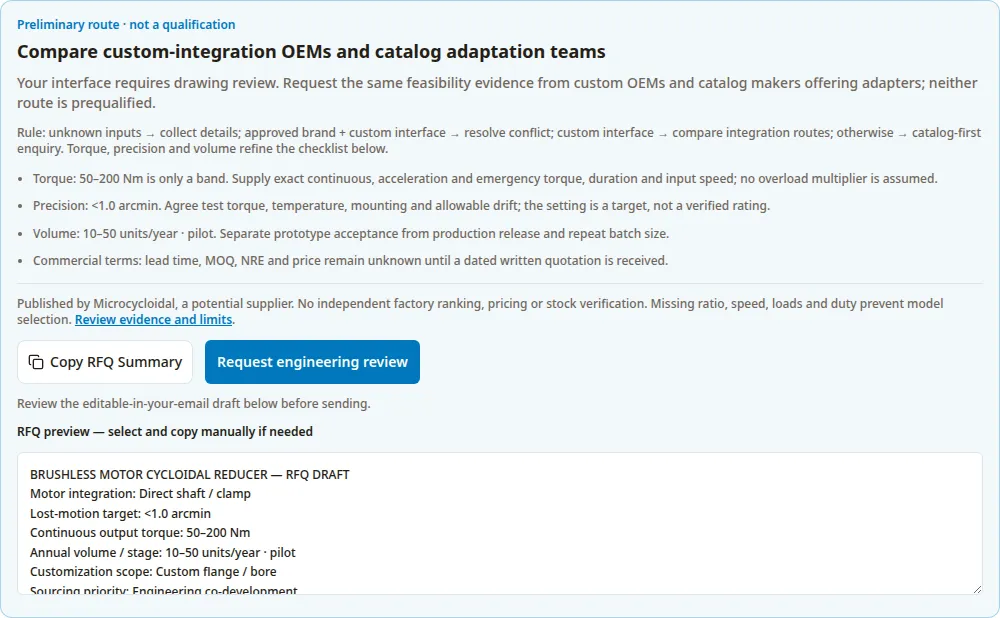
Compare supplier evidence and motor interfaces. Build an RFQ for engineering review.
Start the manufacturer screener ↓Example defaults selected. Choose six inputs for an immediate sourcing route and RFQ. “Not sure” flags missing details. No live supplier data.
Use the tool to organize an enquiry, then use the evidence below to qualify a specific model. This supplier-authored guide does not independently rank factories.
Model-specific limits
Compare rated, acceleration and emergency torque separately. A family-level shock statement cannot qualify an untested assembly.
Match test conditions
Lost motion includes elastic effects. Compare the same load band, mounting and temperature before accepting a quoted angle.
Adapters may be available
Catalog sourcing can include an adapter on request. Custom integration is a drawing review, not an automatic reason to reject catalog makers.
Agree the drawing
Specify datums, runout and fits for the actual motor and reducer. ISO notation alone supplies no numeric acceptance limit.
Review the assembly
Determine rotor behaviour and balancing requirements with the designer. Do not apply a rigid-rotor grade to the intentional eccentric motion without an assembly analysis.
Test the complete axis
A reducer specification cannot guarantee robot positioning performance; include structure, encoder, control and temperature in system tests.
Named products are examples of published capabilities. Unknown commercial data stays unknown; it is not a basis for a preferred-supplier ranking.
| Dimension | Nabtesco RV / RS | Sumitomo Fine Cyclo | SPINEA TwinSpin | Custom integration OEM |
|---|---|---|---|---|
| Published technical evidence | Nabtesco RV/RS catalog: confirm exact model limits | Sumitomo T-Series: <0.5 arcmin; adapters on request | SPINEA: documented lost-motion method and setting tradeoffs | Microcycloidal or another OEM: request signed model ratings and test reports |
| Motor interface | Check input arrangement and adapter drawing | Confirm requested keyway/clamping adapter | Confirm reducer/actuator configuration with engineering | Review shaft, pilot, rotor retention, cooling and service access |
| Precision acceptance | Use model-specific catalog method | Match size, ratio and lost-motion option | Match setting and friction/no-load torque | Agree test torque, mounting, temperature and acceptance limit |
| Lead time / MOQ / NRE | Unknown — request dated regional quote | Unknown — request dated regional quote | Unknown — request dated regional quote | Unknown — request dated engineering quote |
| Commercial comparison | Include adapters, stock, warranty and support | Include requested options and assembly work | Include configuration and service requirements | Include NRE, drawing ownership and repeat-order terms |
Technical references: [Nabtesco RV / RS technical catalog], [Sumitomo Fine Cyclo T-Series product specification], [SPINEA: When the Motion is Lost]. Price, MOQ, NRE, stock, service response and lead time require dated quotations for your configuration and region.
| Architecture | Connection | Packaging / service | Required verification |
|---|---|---|---|
| Modular flange + coupling | Separate motor, coupling and adapter | Allows component replacement; reserve coupling space | Check coupling speed, alignment and guarding |
| Direct shaft / clamp | Motor shaft engages reducer input | May reduce adapter space; drawing agreement required | Check shaft support, clamping, runout and thermal growth |
| Integrated frameless BLDC | Rotor/stator integrated into actuator | Potential packaging benefit with more assembly responsibility | Validate air gap, rotor retention, cooling, encoder and insulation |
Confirm the motor shaft support and permitted loads with both suppliers. For a frameless assembly, assign responsibility for rotor retention, stator installation, encoder referencing and thermal testing.
SPINEA describes lost motion using the curve centreline at ±3% nominal torque. Full-load twist, hysteresis and mechanical clearance are separate quantities. [SPINEA: When the Motion is Lost]
Ask for the curve, torque reference, mounting, temperature and repeatability. Compare stiffness in the same torque range and units. ISO 9283 addresses robot performance; it supplies no universal component acceptance threshold. [ISO 9283:1998 — Robot performance and test methods]
Acceptance action: agree the application limit and prototype test method before ordering. A quoted sub-arcminute value does not by itself guarantee end-effector accuracy.
Document radial load, axial load, wheel or arm offset and overturning moment at the reducer flange. Check combined-load limits, bearing life and mounting stiffness. External supports remain necessary when the selected assembly cannot carry the load.
The T-Series example includes tapered roller output bearings. This is a configuration fact, not proof that every reducer can replace a wheel hub. [Sumitomo Fine Cyclo T-Series product specification]
Distinguish continuous speed from intermittent maximum speed. Test the coupled motor and reducer at the actual ambient, duty cycle and mounting condition. Use the selected model’s limits for housing temperature, seals and lubricant.
This is a proposed audit checklist, not a comparative materials experiment. Public evidence here cannot establish a universal material grade, grinding-only rule or failure time.
| Area | What to specify | Evidence to request | Limit of the inference |
|---|---|---|---|
| Material selection | Grade and material certificate | Heat-treatment specification and supplier traceability | A grade name alone does not demonstrate endurance |
| Heat treatment | Hardness, effective case depth where relevant, distortion | Agreed inspection method and batch certificate | Cryogenic treatment is not a universal requirement |
| Profile finish | Form error and surface integrity after final machining | Calibrated inspection against the drawing | No process name alone guarantees accuracy or service life |
| EDM or grinding route | Surface condition and any recast-layer removal | Process qualification and representative fatigue/endurance evidence | Do not infer a 500-hour failure time from the machining method |
| Endurance | Lost-motion drift, wear, temperature and lubricant condition | Duty-cycle test plan with agreed limits and duration | Prototype results do not establish fleet failure rates |
Illustration only, USD, 100 units. Quote A and Quote B are invented buyer inputs, not offers from named manufacturers or market averages. No measured failure-rate dataset is available.
| Input / output | Quote A (USD) | Quote B (USD) |
|---|---|---|
| Reducer / unit | $800 | $650 |
| Adapter / unit | $100 | $0 |
| Assembly labor / unit | $50 | $50 |
| One-time NRE | $0 | $5,000 |
| Quantity | 100 units | 100 units |
| Acquisition subtotal | $95,000 | $75,000 |
| Freight / tax / service / downtime | Unknown — excluded | Unknown — excluded |
With these assumptions only, B saves $20,000 at 100 units. Incremental NRE is $5,000 and per-unit difference is $250: break-even is 20 units; savings begin above 20. Add freight, tax, financing and realistic service scenarios before making a TCO decision. A lower subtotal does not demonstrate equivalent performance.
Repeated starts and emergency stops impose different loads.
Action: Calculate each load case and compare with the exact reducer limits; agree allowable duration and event count.
Motor losses can raise bearing and lubricant temperatures.
Action: Validate the coupled thermal system. Have the designer assess cooling or isolation without compromising the structural joint.
Tighter settings can increase friction; the rest of the machine may dominate positioning error.
Action: Allocate an axis error budget and measure no-load torque before paying for a tighter option.
Zero-load clearance and loaded lost motion describe different behaviour.
Action: Request the test procedure and hysteresis curve; compare the same load band and temperature.
An unsuitable requirement can add cost without validating the assembly.
Action: Agree interface tolerances and balancing procedure with both motor and reducer designers.
Stock, region, options and quantity can reverse the expected tradeoff.
Action: Send an identical RFQ to multiple qualified suppliers and compare dated written offers.
Suggested buyer workflow. Set acceptance limits and test duration for your duty cycle rather than treating this checklist as a certification scheme.
| Gate | Deliverable | Review | Hold / next action |
|---|---|---|---|
| 01 — Feasibility | Torque-speed-time cycle, loads and CAD envelope | Rated, acceleration, emergency, speed and bearing limits | Hold if the vendor cannot confirm the duty envelope |
| 02 — Interface / quotation | Signed motor interface drawing and itemized quote | Datums, fits, cooling, NRE, MOQ, lead time and delivery terms | Resolve drawing or schedule conflicts before ordering |
| 03 — Prototype acceptance | Agreed inspection and functional test reports | Lost motion, stiffness, runout and running torque at specified conditions | Hold if a measured result exceeds the agreed application limit |
| 04 — Duty validation | Thermal and endurance logs under representative duty | Cold start, hot duty, peak loads and post-test wear | Hold if any model-specific temperature, load or drift limit is exceeded |
| 05 — Production release | Control plan, traceability and quality agreement | Repeatability, change control, service and delivery commitments | Do not release production until deviations are closed |
These scenarios show how to structure an RFQ. Values are assumed requirements, not validated product capabilities or documented customer deployments.
Premise: Illustrative RFQ: 160 Nm continuous, 450 Nm emergency target, <0.8 arcmin lost motion; ratio and duty still to confirm.
Process: Compare motor integration, measured lost motion, peak-event allowance and complete-axis stiffness.
Decision: Shortlist catalog or custom candidates only after the same acceptance test. No collision-safety or TCP-repeatability guarantee follows from reducer torque.
Premise: Illustrative RFQ: 320 Nm continuous, 1,200 Nm transient target; wheel offset and vehicle load distribution unknown.
Process: Resolve radial/axial wheel loads, overturning moment, braking and duty cycle before choosing a bearing arrangement.
Decision: Request model-specific combined-load calculations. An integrated output bearing may remove an external hub only after verification.
Premise: Illustrative RFQ: 25 Nm continuous and <0.5 arcmin lost motion; cleanliness and service environment to confirm.
Process: Compare friction, torque ripple, precision settings and system repeatability at cold and hot conditions.
Decision: Request prototype measurements. This example does not establish suitability for patient-contact or surgical use.
Premise: Illustrative RFQ: 220 Nm continuous and 700 Nm transient target; wind spectrum and ambient range to confirm.
Process: Check wind moment, sealing, low-temperature starting torque and safe holding strategy.
Decision: Retain a brake or other holding provision where the risk assessment requires it. A high ratio alone does not guarantee self-locking.
Sourcing
Start from the same duty cycle and interface drawing. Check approval requirements, model ratings, test evidence and the full written quotation. A supplier category does not determine price, delivery or quality.
Sourcing
No. It is a transparent rule-based shortlist aid from Microcycloidal, a potential supplier. It has no live stock, pricing or independently audited factory data. Use its RFQ checklist to obtain comparable evidence.
Integration
Not necessarily. The Fine Cyclo T-Series page lists motor adapters on request. Confirm the exact interface, feasibility, quantity and schedule directly with the supplier.
Precision
SPINEA describes a measurement with fixed input and housing and output displacement at ±3% nominal torque on the curve centreline. Request each supplier’s method, load, mounting and temperature; do not equate it with full-load deflection.
Precision
Its scope is industrial robot performance and test methods. Use the reducer manufacturer’s documented method and an agreed component acceptance specification.
Integration
No universal BLDC runout value follows from this standard. It defines geometrical specification language. Obtain numeric tolerances and datums from the motor/reducer interface drawing.
Integration
No universal grade is established by the public ISO abstract. ISO 21940-11 covers rigid-rotor balancing procedures; the designer must select the applicable grade, speed, planes and assembly condition.
Reliability
No. Nabtesco’s RV/RS feature statement includes model exclusions. Confirm the selected model’s emergency torque, event duration and repetition limits; never transfer a family claim to another supplier.
Reliability
Check the selected model’s continuous and intermittent input speed, actual ratio, thermal duty and lubrication limits. A motor’s maximum speed alone does not establish gearbox compatibility.
Reliability
Ask for the exact reducer-approved lubricant, fill quantity, orientation and service interval. Confirm compatibility before changing or mixing products. This page supplies no universal grease substitution or temperature ceiling.
Sourcing
Public evidence here is insufficient to quote these values. Request a dated written offer separating prototype quantity, annual volume, repeat batch size, NRE, adapter cost and destination terms.
Quality
No. Request material, heat-treatment and profile inspection records, then validate the intended duty cycle. There is no verified cross-supplier wear-life dataset on this page.
Alternatives
Compare candidates at the required ratio, duty, mass, stiffness, efficiency, peak loads and cost. This page does not establish a universal stiffness, lifetime or cost multiplier between mechanisms.
Integration
Only after combined radial, axial and overturning loads, mounting stiffness and life are verified for the selected model. Some component reducers require external bearings.
Cost
It is hypothetical arithmetic, not market pricing. It omits tax, freight, financing, downtime and warranty costs. Add these from your actual quotation and service assumptions before approval.
Next step
Send continuous/peak torque and duration, speed-time cycle, ratio, motor CAD and interface, output loads, precision test conditions, environment, quantity and required date. Request written feasibility and delivery commitments.
Reviewed . This guide uses manufacturer publications and official ISO scope records. ISO scope checks do not claim access to the complete paid standards. No independent teardown dataset, supplier price survey or verified delivery comparison is available.
Microcycloidal publishes this page and may quote on enquiries. The screener uses the visible rules above without a numerical score or factory qualification. Manufacturing checklists are proposed buyer actions; the cost model and scenarios are hypothetical. Confirm dated catalogs, drawings, model limits and written commercial terms before purchase.
Responsible publisher: Micro Cycloidal company information. First recorded in git . this is creation provenance, not verified public publication. Review this guide by 30 April 2027, or sooner when a cited model or quotation changes.
Locator: Structure and Features; rating tables and selection notes.
Scope / limit: Describes RV mechanisms and RS products. The 5× shock statement excludes some models; it is not a universal cycloidal rating. No comparable commercial quotations are provided.
Locator: Overview and technical ratings: lost motion, torque, bearings and motor adapters.
Scope / limit: T-Series lists <0.5 arcmin lost motion, integrated tapered roller bearings and adapters on request. These features do not apply to every Fine Cyclo model; check size, ratio and duty.
Locator: Lost motion definition and Lost Motion settings sections.
Scope / limit: Manufacturer explanation of measurement at ±3% nominal torque and the friction/precision tradeoff. Not an independent cross-brand ranking.
Locator: Official title and edition record.
Scope / limit: Robot-system performance scope. It does not establish a universal reducer lost-motion acceptance limit or certify a gearbox for medical use.
Locator: Official abstract: geometrical specification language and interpretation.
Scope / limit: Defines how tolerances are specified. Numerical runout limits and fits must come from the agreed interface drawing, not an assumed universal 15 µm rule.
Locator: Official abstract; edition 1 and amendment 1:2022 record.
Scope / limit: Procedures and tolerances for rigid rotors. The public abstract does not mandate G2.5 for every BLDC reducer; the assembly designer must specify the grade, speed and correction planes.
Copy your RFQ draft from the screener and add the missing ratio, speed-time cycle, peak events, output loads and motor CAD. Ask Microcycloidal or another shortlisted supplier for model feasibility, prototype testing, an itemized quote and a written delivery date.
Return to your RFQ draft ↑Inquiry Email
Include ratio, torque, backlash, interface drawings, quantity plan, and destination terms.
Instant Chat
WhatsApp Engineering Support
Use chat for quick routing; drawings and technical details can move to email.